what causes an air mass to have low pressure

A clockwise spinning low-force per unit area area or whirlwind of southern Commonwealth of australia. The center of the spiral-shaped cloud system is also the center of the low.

A low-pressure system over Republic of iceland.
In meteorology, a low-pressure area, low area or depression is a region where the atmospheric pressure is lower than that of surrounding locations. Generally, A low-pressure area is commonly associated with inclement weather (such as cloudy, windy, with possible rain or storms),[1] while a high-pressure surface area is associated with lighter winds and clear skies.[2] Winds circle anti-clockwise around lows in the northern hemisphere, and clockwise in the southern hemisphere, due to opposing Coriolis forces. Low-pressure systems class under areas of wind departure that occur in the upper levels of the atmosphere (aloft). The germination process of a low-pressure surface area is known as cyclogenesis. In meteorology, atmospheric divergence aloft occurs in two kinds of places:
- The first is in the area on the due east side of upper troughs, which grade half of a Rossby wave within the Westerlies (a trough with big wavelength that extends through the troposphere).
- A 2d is an area where wind divergence aloft occurs ahead of embedded shortwave troughs, which are of smaller wavelength.
Diverging winds aloft, alee of these troughs, cause atmospheric lift within the troposphere below equally air flows upwards away from the surface, which lowers surface pressures as this upward movement partially counteracts the force of gravity packing the air close to the ground.
Thermal lows class due to localized heating caused past greater solar incidence over deserts and other land masses. Since localized areas of warm air are less dense than their environs, this warmer air rises, which lowers atmospheric pressure level most that portion of the Globe's surface. Large-scale thermal lows over continents aid drive monsoon circulations. Low-pressure areas can as well form due to organized thunderstorm activeness over warm water. When this occurs over the tropics in concert with the Intertropical Convergence Zone, information technology is known as a monsoon trough. Monsoon troughs achieve their northerly extent in August and their southerly extent in February. When a convective low acquires a well-hot circulation in the torrid zone it is termed a tropical cyclone. Tropical cyclones can form during any month of the yr globally but tin can occur in either the northern or southern hemisphere during Dec.
Atmospheric elevator volition besides generally produce cloud cover through adiabatic cooling in one case the air temperature drops below the dew point as it rises, although the low-pressure area typically brings cloudy skies, which human activity to dampen diurnal temperature extremes. Since clouds reflect sunlight, incoming shortwave solar radiation decreases, which causes lower temperatures during the twenty-four hour period. At nighttime the absorptive effect of clouds on outgoing longwave radiation, such equally rut energy from the surface, allows for warmer night-fourth dimension minimums in all seasons. The stronger the area of low pressure level, the stronger the winds experienced in its vicinity. Globally, low-pressure systems are most often located over the Tibetan Plateau and in the lee of the Rocky mountains. In Europe (particularly in the British Isles and Netherlands), recurring low-force per unit area weather systems are typically known every bit "low levels".
Formation [edit]
Cyclogenesis is the development and strengthening of cyclonic circulations, or low-pressure areas, within the atmosphere.[3] Cyclogenesis is the opposite of cyclolysis, and has an anticyclonic (loftier-pressure level system) equivalent which deals with the germination of loftier-pressure areas—anticyclogenesis.[four] Cyclogenesis is an umbrella term for several different processes, all of which issue in the evolution of some sort of cyclone. Meteorologists use the term "whirlwind" where circular pressure systems flow in the direction of the Earth'due south rotation,[5] [6] which normally coincides with areas of depression force per unit area.[7] [viii] The largest depression-pressure level systems are common cold-core polar cyclones and extratropical cyclones which lie on the synoptic scale. Warm-core cyclones such every bit tropical cyclones, mesocyclones, and polar lows lie inside the smaller mesoscale. Subtropical cyclones are of intermediate size.[9] [ten] Cyclogenesis can occur at various scales, from the microscale to the synoptic scale. Larger-scale troughs, also called Rossby waves, are synoptic in scale.[xi] Shortwave troughs embedded within the flow around larger scale troughs are smaller in scale, or mesoscale in nature.[12] Both Rossby waves and shortwaves embedded within the menstruation around Rossby waves migrate equatorward of the polar cyclones located in both the Northern and Southern hemispheres.[13] All share one important aspect, that of upwardly vertical movement inside the troposphere. Such upward motions subtract the mass of local atmospheric columns of air, which lowers surface force per unit area.[xiv]
Extratropical cyclones class every bit waves forth weather fronts due to a passing by shortwave aloft or upper-level jet streak[ clarification needed ] earlier occluding subsequently in their life cycle as cold-cadre cyclones.[15] [xvi] [17] [18] Polar lows are pocket-sized, short-lived atmospheric depression-pressure systems that occur over the bounding main areas poleward of the main polar front in both the Northern and Southern Hemispheres. They are part of the larger class of mesoscale weather-systems. Polar lows tin can exist difficult to detect using conventional weather reports and are a hazard to loftier-latitude operations, such as aircraft and offshore platforms. They are vigorous systems that accept virtually-surface winds of at to the lowest degree 17 metres per second (38 mph).[19]
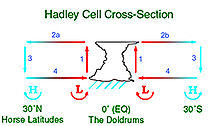
This depiction of the Hadley cell shows the process which sustains low-pressure areas. Diverging winds aloft permit for lower pressure and convergence at the Earth's surface, which leads to upwards move.
Tropical cyclones grade due to latent heat driven by significant thunderstorm activeness, and are warm-core with well-defined circulations.[twenty] Certain criteria need to be met for their formation. In almost situations, water temperatures of at least 26.5 °C (79.vii °F) are needed down to a depth of at least 50 chiliad (160 ft);[21] waters of this temperature crusade the overlying temper to be unstable enough to sustain convection and thunderstorms.[22] Another factor is rapid cooling with top, which allows the release of the heat of condensation that powers a tropical cyclone.[21] High humidity is needed, especially in the lower-to-mid troposphere; when at that place is a great deal of wet in the atmosphere, atmospheric condition are more than favorable for disturbances to develop.[21] Low amounts of current of air shear are needed, as high shear is disruptive to the storm's circulation.[21] Lastly, a formative tropical cyclone needs a pre-existing system of disturbed weather, although without a circulation no cyclonic development volition take place.[21] Mesocyclones form equally warm core cyclones over land, and can lead to tornado formation.[23] Waterspouts can also form from mesocyclones, but more than often develop from environments of high instability and low vertical wind shear.[24]
In deserts, lack of ground and plant moisture that would normally provide evaporative cooling can lead to intense, rapid solar heating of the lower layers of air. The hot air is less dense than surrounding cooler air. This, combined with the ascent of the hot air, results in a low-pressure level area called a thermal depression.[25] Monsoon circulations are acquired by thermal lows which class over large areas of country and their strength is driven by how land heats more apace than the surrounding nearby sea. This generates a steady wind blowing toward the land, bringing the moist near-surface air over the oceans with it.[26] Similar rainfall is caused by the moist ocean-air being lifted upwardly by mountains,[27] surface heating,[28] convergence at the surface,[29] divergence aloft, or from storm-produced outflows at the surface.[30] Nevertheless the lifting occurs, the air cools due to expansion in lower force per unit area, which in turn produces condensation. In winter, the land cools off quickly, but the body of water keeps the heat longer due to its higher specific heat. The hot air over the bounding main rises, creating a low-force per unit area area and a cakewalk from land to ocean while a large area of drying high force per unit area is formed over the land, increased by winter cooling.[26] Monsoons resemble sea and land breezes, terms usually referring to the localized, diurnal (daily) cycle of circulation near coastlines everywhere, but they are much larger in scale - as well stronger and seasonal.[31]
Climatology [edit]
Mid-latitudes and subtropics [edit]

QuikSCAT image of typical extratropical cyclones over the ocean. Note the maximum winds on the poleward side of the occluded front end.
Large polar cyclones help determine the steering of systems moving through the mid-latitudes, south of the Arctic and north of the Antarctic. The Arctic oscillation provides an alphabetize used to gauge the magnitude of this consequence in the Northern Hemisphere.[32] Extratropical cyclones tend to form east of climatological trough positions aloft well-nigh the east coast of continents, or west side of oceans. A written report of extratropical cyclones in the Southern Hemisphere shows that between the 30th and 70th parallels there are an average of 37 cyclones in being during whatsoever 6-hour period.[34] A split study in the Northern Hemisphere suggests that approximately 234 significant extratropical cyclones class each winter.[35] In Europe, particularly in the Britain and in the netherlands, recurring extratropical low-pressure weather systems are typically known as depressions.[36] [37] [38] These tend to bring wet weather throughout the year. Thermal lows also occur during the summertime over continental areas across the subtropics - such as the Sonoran Desert, the Mexican plateau, the Sahara, South America, and Southeast Asia.[25] The lows are nigh commonly located over the Tibetan plateau and in the lee of the Rocky mountains.
Monsoon trough [edit]
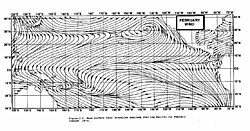
Feb position of the ITCZ and monsoon trough in the Pacific Ocean, depicted by surface area of convergent streamlines offshore Australia and in the equatorial eastern Pacific
Elongated areas of low pressure class at the monsoon trough or intertropical convergence zone as role of the Hadley jail cell circulation.[39] Monsoon troughing in the western Pacific reaches its zenith in latitude during the late summer when the winter surface ridge in the opposite hemisphere is the strongest. It can reach equally far as the 40th parallel in East Asia during August and 20th parallel in Australia during Feb. Its poleward progression is accelerated by the onset of the summer monsoon which is characterized by the development of lower air pressure over the warmest part of the various continents.[40] [41] The large-scale thermal lows over continents aid create pressure level gradients which bulldoze monsoon circulations.[42] In the southern hemisphere, the monsoon trough associated with the Australian monsoon reaches its most southerly latitude in February,[43] oriented along a west-northwest/east-southeast centrality. Many of the world's rainforests are associated with these climatological low-pressure systems.[44]
Tropical whirlwind [edit]

Infrared prototype of a powerful northern hemisphere cyclone, Goni, nigh its superlative intensity
Tropical cyclones generally need to form more than 555 km (345 mi) or poleward of the 5th parallel north and 5th parallel south, allowing the Coriolis consequence to deflect winds blowing towards the depression-pressure center and creating a circulation.[21] Worldwide, tropical whirlwind activity peaks in late summer, when the difference between temperatures aloft and body of water surface temperatures is the greatest. Nevertheless, each item basin has its own seasonal patterns. On a worldwide scale, May is the least active month while September is the most active calendar month. November is the just calendar month that activity in all the tropical cyclone basins is possible.[45] Nearly one-third of the earth's tropical cyclones form within the western Pacific Ocean, making it the near active tropical cyclone basin on Earth.[46]
Associated weather [edit]
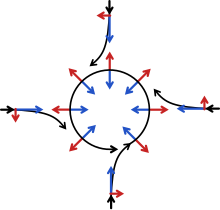
Schematic representation of flow (represented in black) around a low-pressure level area in the Northern hemisphere. The pressure-gradient force is represented by blue arrows, the Coriolis acceleration (always perpendicular to the velocity) past red arrows.
Wind is initially accelerated from areas of high pressure to areas of low pressure.[47] This is due to density (or temperature and moisture) differences betwixt two air masses. Since stronger high-pressure level systems comprise cooler or drier air, the air mass is denser and flows towards areas that are warm or moist, which are in the vicinity of low-pressure areas in accelerate of their associated cold fronts. The stronger the pressure difference, or pressure gradient, betwixt a loftier-pressure arrangement and a low-force per unit area organization, the stronger the wind.[48] Thus, stronger areas of low pressure are associated with stronger winds.
The Coriolis force caused by the Earth's rotation is what gives winds effectually low-pressure areas (such as in hurricanes, cyclones, and typhoons) their counter-clockwise (anticlockwise) circulation in the northern hemisphere (as the wind moves inward and is deflected right from the center of high pressure) and clockwise circulation in the southern hemisphere (every bit the wind moves in and is deflected left from the middle of high force per unit area).[49] A tropical cyclone differs from a hurricane or typhoon based merely on geographic location.[50] Note that a tropical cyclone is fundamentally different from a mid-latitude whirlwind.[51] A hurricane is a storm that occurs in the Atlantic Ocean and northeastern Pacific Ocean, a typhoon occurs in the northwestern Pacific Bounding main, and a tropical cyclone occurs in the south Pacific or Indian Ocean.[50] [52] Friction with land slows down the wind flowing into low-pressure systems and causes current of air to flow more than inward, or flowing more ageostrophically, toward their centers.[48] Tornadoes are often too small-scale, and of too brusque elapsing, to be influenced by the Coriolis forcefulness, only may be so-influenced when arising from a low-pressure arrangement.[53] [54]
See as well [edit]
- E Asian Monsoon
- High-pressure surface area
- Intertropical Convergence Zone
- North American Monsoon
- Surface weather analysis
- Tropical wave
- Trough (meteorology)
- Weather condition map
References [edit]
- ^ "Cyclone". American Meteorological Society. amsglossary.allenpress.com. Glossary of Meteorology. Allen Press. 2008. Archived from the original on 2008-10-04. Retrieved 2009-03-02 .
- ^ Williams, Jack (2007). "What's happening inside highs and lows". Weather. Us Today . Retrieved 2009-02-16 .
- ^ "Cyclogenesis". nsidc.org. Arctic Climatology and Meteorology. National Snow and Ice Data Center. 2006. Archived from the original on 2006-08-xxx. Retrieved 2009-02-21 .
- ^ "Cyclogenesis". American Meteorological Society. amsglossary.allenpress.com. Glossary of Meteorology. Allen Press. 2009. Retrieved 2009-02-21 .
- ^ Glossary of Meteorology (June 2000). "Cyclonic circulation". American Meteorological Guild. Retrieved 2008-09-17 .
- ^ Glossary of Meteorology (June 2000). "Cyclone". American Meteorological Society. Archived from the original on 2008-ten-04. Retrieved 2008-09-17 .
- ^ BBC Weather Glossary (July 2006). "Cyclone". British Broadcasting Corporation. Archived from the original on 2006-08-29. Retrieved 2006-10-24 .
- ^ "UCAR Glossary — Cyclone". meted.ucar.edu . Retrieved 2006-10-24 .
- ^ Robert Hart (2003-02-18). "Cyclone Stage Analysis and Forecast: Help Page". Florida State University. Retrieved 2006-10-03 .
- ^ I. Orlanski (1975). "A rational subdivision of scales for atmospheric processes". Bulletin of the American Meteorological Club. 56 (5): 527–530. Bibcode:1975BAMS...56..527.. doi:10.1175/1520-0477-56.5.527.
- ^ "Rossby wave". American Meteorological Society. amsglossary.allenpress.com. Glossary of Meteorology. Allen Printing. June 2000. Archived from the original on 2010-12-31. Retrieved 2009-11-06 .
- ^ "Short wave". American Meteorological Lodge. amsglossary.allenpress.com. Glossary of Meteorology. Allen Press. June 2000. Archived from the original on 2011-05-14. Retrieved 2009-11-06 .
- ^ Glossary of Meteorology (June 2000). "Polar vortex". American Meteorological Society. Archived from the original on 2011-01-09. Retrieved 2009-12-24 .
- ^ Joel Norris (2005-03-19). "QG Notes" (PDF). Academy of California, San Diego. Archived from the original (PDF) on 2010-06-26. Retrieved 2009-ten-26 .
- ^ Glossary of Meteorology (2009). Short Moving ridge. Archived 2009-06-09 at the Wayback Car American Meteorological Society. Retrieved on 2009-03-02.
- ^ Glossary of Meteorology (2009). Upper-Level Trough. Archived 2009-06-09 at the Wayback Machine American Meteorological Social club. Retrieved on 2009-03-02.
- ^ Carlyle H. Launder, Stacey H. Heikkinen, Chi-Sann Liou, and Wendell A. Nuss (1989). A Rapid Cyclogenesis Result during GALE IOP nine. Monthly Atmospheric condition Review pp. 234–257. Retrieved on 2008-06-28.
- ^ Shay Johnson (2001-09-25). "The Norwegian Whirlwind Model" (PDF). weather.ou.edu. Archived from the original (PDF) on 2006-09-01. Retrieved 2006-10-11 .
- ^ East. A. Rasmussen & J. Turner (2003). Polar Lows: Mesoscale Atmospheric condition Systems in the Polar Regions . Cambridge Academy Press. p. 612. ISBN978-0-521-62430-five.
- ^ Atlantic Oceanographic and Meteorological Laboratory, Hurricane Research Sectionalisation (2004). "Oftentimes Asked Questions: What is an extra-tropical cyclone?". NOAA. Retrieved 2007-03-23 .
- ^ a b c d e f Chris Landsea (2009-02-06). "Oftentimes Asked Questions: How practise tropical cyclones form?". National Oceanic and Atmospheric Assistants. Retrieved 2009-12-31 .
- ^ Chris Landsea (2004-08-13). "Oft Asked Questions: Why practise tropical cyclones require 80 °F (27 °C) ocean temperatures to class?". National Oceanic and Atmospheric Administration. Retrieved 2006-07-25 .
- ^ Glossary of Meteorology (2009). "Mesocyclone". American Meteorological Social club. Archived from the original on 2006-07-09. Retrieved 2006-12-07 .
- ^ Choy, Barry Thou.; Scott M. Spratt (2003-05-13). "Using the WSR-88D to Predict East Primal Florida Waterspouts". NOAA. Archived from the original on 2008-06-17. Retrieved 2009-12-26 .
- ^ a b Glossary of Meteorology (2009). Thermal Depression. Archived 2008-05-22 at the Wayback Car American Meteorological Society. Retrieved on 2009-03-02.
- ^ a b Dr. Louisa Watts (2009). What causes the west African monsoon? National Centre for Ecology Scientific discipline. Retrieved on 2009-04-04.
- ^ Dr. Michael Pidwirny (2008). CHAPTER 8: Introduction to the Hydrosphere (e). Cloud Formation Processes. Physical Geography. Retrieved on 2009-01-01.
- ^ Bart van den Hurk and Eleanor Blyth (2008). Global maps of Local Land-Atmosphere coupling. Archived 2009-02-25 at the Wayback Machine KNMI. Retrieved on 2009-01-02.
- ^ Robert Penrose Pearce (2002). Meteorology at the Millennium. Bookish Press, p. 66. ISBN 978-0-12-548035-2. Retrieved on 2009-01-02.
- ^ Glossary of Meteorology (June 2000). "Gust Front". American Meteorological Society. Archived from the original on 2011-05-05. Retrieved 2008-07-09 .
- ^ BBC Weather condition (2004-09-01). "The Asian Monsoon". Archived from the original on August 31, 2007. Retrieved 2008-05-22 .
- ^ Todd Mitchell (2004). Arctic Oscillation (AO) fourth dimension serial, 1899 – June 2002. Archived 2003-12-12 at the Wayback Machine Academy of Washington. Retrieved on 2009-03-02.
- ^ Ian Simmonds & Kevin Keay (February 2000). "Variability of Southern Hemisphere Extratropical Cyclone Beliefs, 1958–97". Journal of Climate. 13 (iii): 550–561. Bibcode:2000JCli...thirteen..550S. doi:10.1175/1520-0442(2000)013<0550:VOSHEC>2.0.CO;two. ISSN 1520-0442.
- ^ S.Chiliad. Gulev; O. Zolina & South. Grigoriev (2001). "Winter Storms in the Northern Hemisphere (1958–1999) via the Internet Wayback Machine". Climate Dynamics. 17 (ten): 795–809. Bibcode:2001ClDy...17..795G. doi:x.1007/s003820000145. S2CID 129364159.
- ^ Met Office (2009). Frontal Depressions. Archived 2009-02-24 at the Wayback Motorcar Retrieved on 2009-03-02.
- ^ "Agreement weather".
- ^ "KNMI - Depressie".
- ^ Becca Hatheway (2008). "Hadley Cell". University Corporation for Atmospheric Research. Archived from the original on 2012-05-26. Retrieved 2009-02-xvi .
- ^ National Centre for Medium Range Forecasting (2004-10-23). "Chapter-II Monsoon-2004: Onset, Advocacy and Apportionment Features" (PDF). Ministry of Earth Sciences (India). Archived from the original (PDF) on 2011-07-21. Retrieved 2008-05-03 .
- ^ Australian Broadcasting Corporation (1999-08-11). "Monsoon". Australian Broadcasting Corporation . Retrieved 2008-05-03 .
- ^ Mary E. Davis & Lonnie G. Thompson (2005). "Forcing of the Asian monsoon on the Tibetan Plateau: Bear witness from high-resolution water ice core and tropical coral records". Journal of Geophysical Research. 110 (D4): one of 13. Bibcode:2005JGRD..110.4101D. doi:ten.1029/2004JD004933.
- ^ U. Southward. Navy (1998-01-22). "1.2 Pacific Ocean Surface Streamline Pattern". Retrieved 2006-eleven-26 .
- ^ Hobgood (2008). "Global Design of Surface Pressure and Current of air". Ohio Country Academy. Archived from the original on 2009-03-xviii. Retrieved 2009-03-08 .
- ^ Atlantic Oceanographic and Meteorological Laboratory, Hurricane Research Division (2009-02-06). "Ofttimes Asked Questions: When is hurricane flavour?". National Oceanic and Atmospheric Administration. Retrieved 2009-12-24 .
- ^ "Examining the ENSO" (PDF). James B Elsner, Kam-Biu Liu. 2003-ten-08. Retrieved 2007-08-eighteen .
- ^ BWEA (2007). Education and Careers: What is wind? Archived 2011-03-04 at the Wayback Machine British Wind Energy Association. Retrieved on 2009-02-xvi.
- ^ a b JetStream (2008). Origin of Wind. National Weather Service Southern Region Headquarters. Retrieved on 2009-02-16.
- ^ Nelson, Stephen (Fall 2014). "Tropical Cyclones (Hurricanes)". Current of air Systems: Low Pressure Centers. Tulane University. Retrieved 2016-12-24 .
- ^ a b "What is the difference between a hurricane, a cyclone, and a typhoon?". Body of water FACTS. National Ocean Service. Retrieved 2016-12-24 .
- ^ "COMPARE AND Contrast: MID-LAT Cyclone AND HURRICANE". www.theweatherprediction.com . Retrieved 2020-02-24 .
- ^ "What is a Hurricane, Typhoon, or Tropical Cyclone? | Precipitation Education". pmm.nasa.gov . Retrieved 2020-02-24 .
- ^ Horton, Jennifer. "Does the rotation of the Earth touch on toilets and baseball game games?". SCIENCE, EVERYDAY MYTHS. HowStuffWorks. Retrieved 2016-12-25 .
- ^ "Do Tornadoes Ever Twist in the Same Management?". Scientific discipline — Globe and Space. WONDEROPOLIS. Retrieved 2016-12-25 .
Source: https://en.wikipedia.org/wiki/Low-pressure_area

Post a Comment for "what causes an air mass to have low pressure"