How to Draw a Shed Door Plan Voiew
Building a shed door should exist kept simple, but how unproblematic a structure should yous use?
Building a shed door tin can be a simple chore, do the basics right and you will feel proud every time you go in to your shed. The first part of this page shows yous the types of shed door, the parts of the door and how they become together. I then show y'all how to build a shed door step by step, with pictures of a shed door that recently fabricated.
Let's get started with the different types of door and which is best to build.
There are 3 levels of construction that yous could opt for before deciding to go the whole squealer and purchase a ready-fabricated door and frame.
These types of door are:
- Ledged
- Ledged and braced
- Framed, ledged and braced
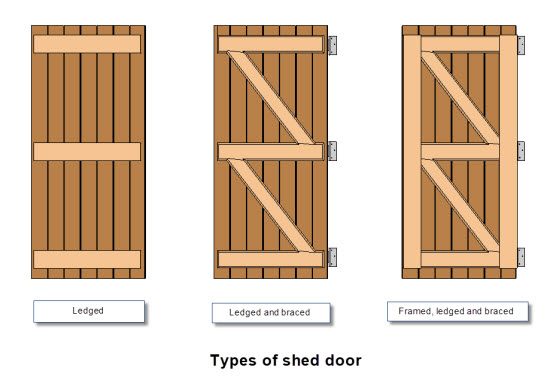
A adept residue of ease of structure can exist accomplished with the ledged and braced door
The unproblematic ledged door has a tendency to driblet over time. Due to expansion and contraction of the timber gravity takes a hold and somewhen the door bolt won't line up with the keep on the frame.
The framed ledged and braced door is the strongest and most stable of the three. The door is prevented from dropping past the diagonal braces and the frame effectually the perimeter helps to make the door more secure and forbid warping of the whole door. Nevertheless this does come at a cost of complexity. To make a expert framed, ledged and braced door you lot volition need to construct mortise and tenon joints for the frame and braces.
A happy medium of the ii is the ledged and braced door. This is the one that I show in the pace past stride edifice a shed door instructions farther down this page. The braces stop the door from dropping/sagging and the ledges provide a proficient opportunity to gear up security bolts between the door and the frame.
And so what are the main components of a ledged and braced door?
The 3 main components are:
- Boards - These form the face up of the door
- Ledges - These are the horizontal boards
- Braces - These are the diagonal boards
`
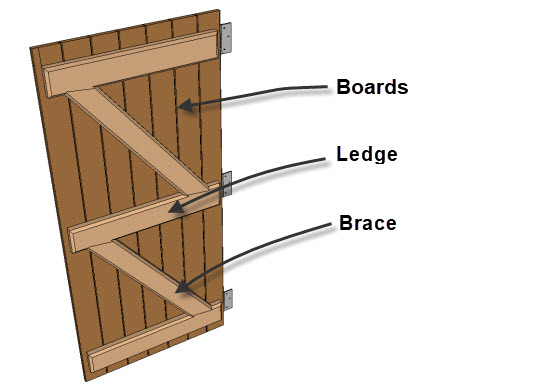 Elements of a shed door
If you are edifice a shed door there is a wide caste of combinations of thickness and type of materials that tin can be used to construct each of these shed door components. But more often than not the thicker and better quality the timber the stronger and more stable the final effect will be.
It goes without saying that many commercially built sheds are built with thin material and of fairly minimal construction. They all piece of work initially but over time the lack of quality starts to show. As the door drops, the boards warp etc.
And then what materials should you use to construct your shed door?
Permit'south start with the boards that form the main body of the door. These are often fabricated from the aforementioned textile as the rest of the shed cladding for economy (only i type of material to order) and visual continuity (the door matches the residue of the shed).
In the example below I departed from this convention to make a door that contrasted with the cladding of the shed. This dissimilarity came with a fourth dimension and cost penalty (though I was very happy with the result).
The simplest type of board to use is the interlocking natural language and groove type. Equally these boards interlock there is no gap between them for draughts. Tongue and groove boards showtime at near 12mm thick (very thin) and go upward to effectually 20mm.
When buying timber (of any type) be aware of the difference between rough sawn and planed timber. Often suppliers will quote the rough sawn size (information technology is ever larger) assuming that you know that the planed timber size will actually be smaller. This isn't a con fob or them being dis-honest information technology is just part of the process of taking timber from a tree to the finished log. Withal to the unititiated it can be confusing:
For cladding size timber :

I prefer rough sawn timber for cladding sheds for three reasons:
-
Firstly it is cheaper, planing timber costs money and so the crude sawn timber is cheaper per square metre.
-
It is thicker, by planing a section you take away some of its thickness every bit strength. Reducing a slice of timber from 16 to 12mm removes 25% of its thickness and 40% of its forcefulness (forcefulness is proportional to the square of thickness).
-
Finally rough sawn timber is better at receiving paint and stain than planed timber. The crude surface holds the paint better, is more absorptive and doesn't suffer from compression of the fibres in the planning process. Paper past US Forest Products Laboratory - 'Wood properties affecting finish service life'
Every bit you will soon see I used 20mm thick, crude sawn, foursquare border boards and and then needed a cover strip to weather proof the gaps between the boards. This was part of my pattern, but 1 that added a little actress to the fourth dimension needed to make the door.
If you are building a shed door for the first fourth dimension and then I would recommend that you use natural language and groove boards.
Ledges and braces
If y'all are using 20mm thick boards for the confront of the door then you could apply the same timber for the ledges and braces. Just if you lot are using that skinny 12mm thick planed material I would recommend that yous use something thicker similar 32x45 for the ledges and braces.
Connections between ledges and braces
There is no structural connection between the two. The traditional method is to make a notch in the ledger as in this sketch and so that the brace is ever in compression.
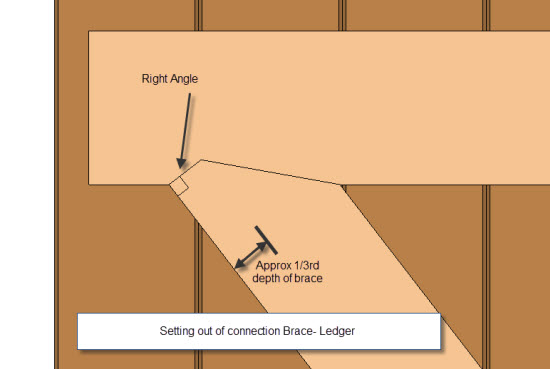 Setting out of the interface between a caryatid and ledge
What connectors are used to connect the ledges and braces to the door?
Traditionally ledged and braced doors are nailed from the front. This works when fixing through thinner textile into a thicker brace or ledge behind.
When fixing with nails like this and then typically the nail lengh is 2.5 times the thickness of the door facing material.
For edifice a shed door similar this you will see that I opted to use screws and utilize them from the inside of the door. This meant that the fixings are protected from the weather and the front end of the door is not damaged. It also gives the front of the door a 'cleaner' appearance.
If you lot utilise a timber such as oak or sweet chestnut for building a shed door so you will also demand to apply Stainless Steel screws as they are resistant to the acidic tannins in these wood.
Nosotros accept now covered the basics of edifice a shed door
So permit's get on with building a shed door
I mentioned earlier that information technology would definitely save you lot time to buy ready cut boards, with a tongue and groove profile, simply would it exist equally much fun?
The boards that I used here were 20mm thick, crude sawn, waney border boards which are almost a waste product from the saw mill that I bought them from.
The boards equally bought were 'moisture' and needed time to air dry (allow approximately one year per inch of thickness). To keep the boards relatively straight, stack them with timber spacers every three-400mm and keep a weight on meridian while they dry out.
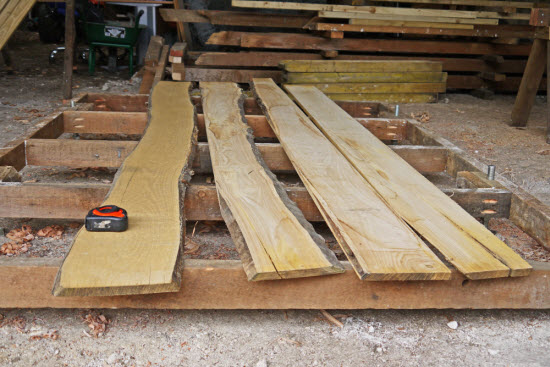 Laying out and assessing the waney edge boards
Cut the boards to width would unremarkably be washed on a table saw
For a small number of boards such as this it is slightly more than time-consuming - but relatively straightforward - to use a standard manus held circular saw. Use a straight floor board as a straight border for the start cutting and then make use of the width guide which is part of the saw'south add together-ons to cut the opposite side.
When cutting the board you will need to employ your ain skill and judgement to cut off the sap woods while maximising the useful width of the lath. It is besides really helpful to inspect the timber and see what features yous desire to cutting out or include.
Y'all demand to cutting off the stop checks and splits but there may exist some interesting knot or grain features that you lot want to include.
The main priority in my view is to maximise the width of boards achieved.
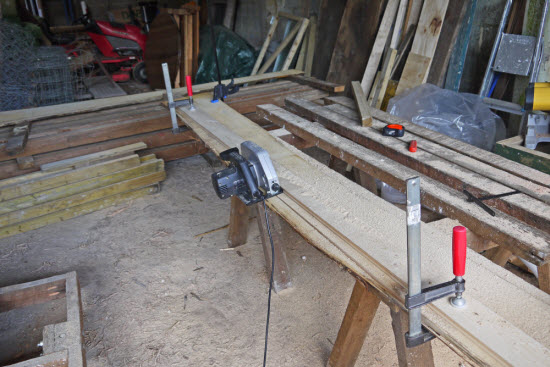 Board clamped to bench and cutting off the waney edge
Decide on the width and height of your door
The dimensions of the door for this shed were 600x1800mm. I cut the boards to length and laid them out to piece of work out what I idea equally the best arrangement.
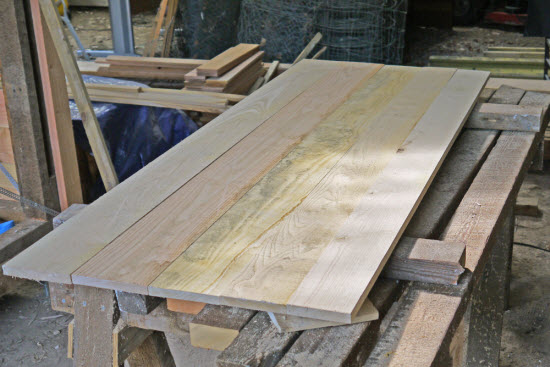 Laying out the boards for the door
When arranging the boards for building a shed door take into account the orientation of the growth rings. Due to the nature of the boards, the outside of the lath will expand and compress at a different charge per unit to the within, leading to an issue known as 'cupping'.
'Cupping' can be mitigated past fixing the heartwood on the outside so that the screws/fixings clamp the board to the batten keeping it equally straight every bit possible.
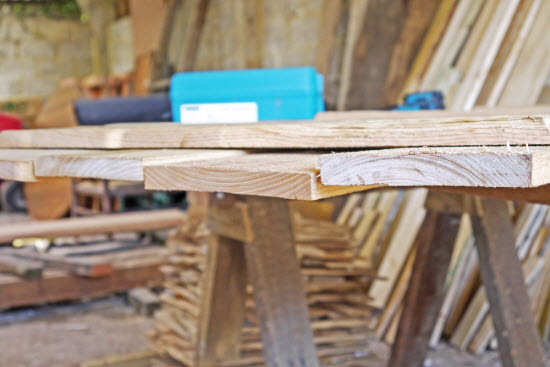 Close upward view of terminate grain. The board nearest the camera has the heartwood facing to the outside. The board next to information technology is placed incorrectly with the heartwood facing inward and will be flipped over to minimise 'cupping'
Adjust the battens and braces on the dorsum of the door
I used 3 boards across the back to course the ledges for this door. The ledges keep the face up of the door straight and provide a connexion between each of the boards. You lot will see that sometimes people attempt to reduce the number of ledges to two. This is a false economic system in my view and makes the door less robust.
When building a shed door, the gradient direction of the braces is important. Timber swells and contracts perpendicular to the grain just varies little dimensionally forth the grain.
Having the braces sloping upwardly from the bottom and middle hinge puts the caryatid into compression. This ways that the weight of the door is trying to close the joint all the time and button the brace into the housing.
If the brace was the other fashion up and so the weight of the door would be trying to open the joint, which given plenty fourth dimension along with wet and dry out cycles, would happen. And then the door would no longer exist foursquare and start to sag.
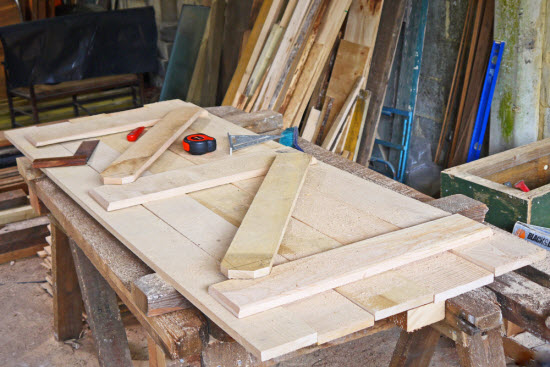 Laying out the ledgers and braces on the back of the door
Note:
When you take a expect at doors on commercial sheds y'all often come across that they accept one brace sloping up and one sloping downwards. I believe that this is to hedge their bets and so that they are guaranteed that at least one caryatid will be effective whichever way up the door is hung.
One time yous have decided on the system for the ledges and the braces, marking these on the boards and cut out the housings. Using a chisel and mallet is the easiest method to do this.
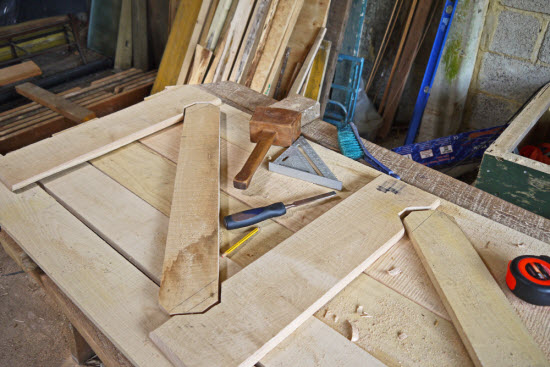 Edifice a shed door - Cutting in the braces with a mallet and chisel
A final bear upon for the ledges and braces is to plane (or use a router) to add together a small chamfer to each of the exposed edges. This increases the visual appeal of the elements and also reduces the possibility of splinters and splitting of the edges.
Fixing the door together
Utilise clamps to pull the boards together and also to hold the ledges and braces in position while y'all fix them in place. The traditional method of fixing the battens to the door was to blast from the 'front end' of the door through the board and ledger.
The end of the nail was then 'clenched' which means bashing the end of the blast over and so that the nail couldn't exist removed. With the advent of mod fixings I choose to secure the battens and braces from the back of the door with screws, thereby giving the front of the door a less cluttered look.
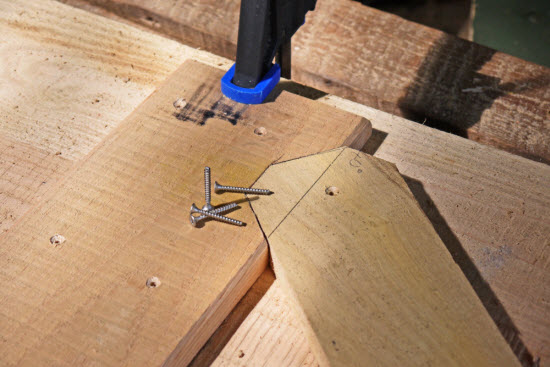 Close upward of brace and fixings. Note that holes for screws are pre-drilled and countersunk
Remember to utilise stainless steel screws when working with sugariness anecdote or oak. The natural tannins within the wood, which are responsible for the timber's durability, are acidic and promote corrosion in apparently steel fixings.
Moreover,sugariness chestnut tin can be prone to splitting when relatively unseasoned then pre-drilling and countersinking the screw holes reduces the possibility of this happening.
Fixing the shed door hinges
Make sure you sympathize where the hinge pin sits in relation to the door opening then that you fit the swivel in the correct position. This volition prevent problems farther downwardly the line when y'all come up to hang the door.
 Fitting the hinges
Fitting the cover strips
If yous are edifice a shed door out of the more commonly available tongue and groove boarding and then y'all can omit this step.
Making a door from plain edge board means that gaps will appear between the boards dependent on the season of the twelvemonth and the wet content of the door. The comprehend strips that nosotros added are to proceed out the worst of the rain and wind. Though having a tongue and groove board or a loose tongue rebated between the boards is definitely an alternative solution.
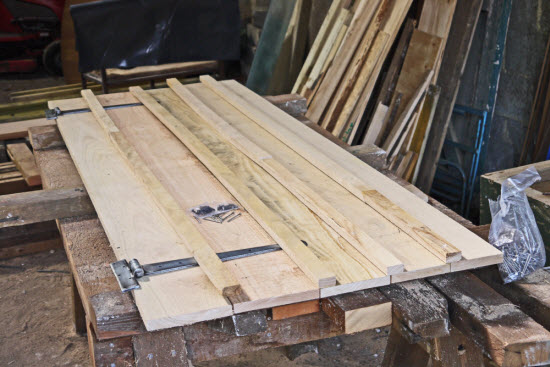 Fitting the cover strips
I liked the appearance of the encompass strips especially after seeing something similar on a visit to my local pub ;-).
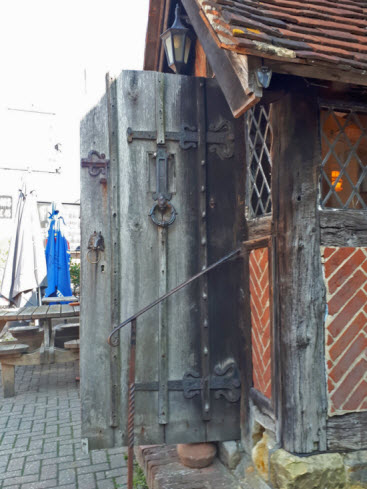 Pub door of similar construction with embrace strips
Finishing the door
With the door complete, apply a couple of coats of linseed oil or teak oil. These treatments soak into the cloth of the timber and add to its natural durability. They also go far easier to recoat and maintain equally unlike paint they repel water and moisture does not get trapped behind them.
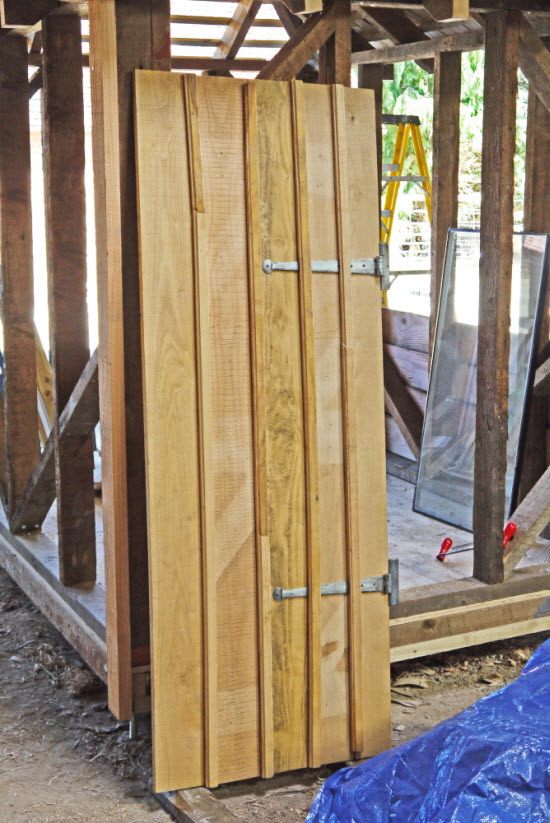 Completed door with glaze of linseed oil
You lot will of grade need some door furniture, a lock and/or a handle to secure the door. The all-time fittings that I take come across are the 'long throw' style locks.
These fittings apply a Euro-way cylinder and have a 20mm foursquare stainless steel bolt with a metallic housing that has sufficient tolerance to adjust the sort of timber movement to be expected on a shed.
I chose to make a simple slide bolt out of timber for everyday opening and closing, with a more secure bolt for when the shed has contents that are to exist left unattended.
Notice out more about the different types of shed door latch here
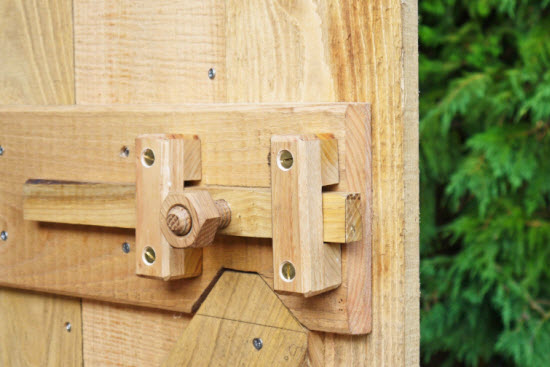 Simple timber slide bolt
Related posts:
- How to hang the shed door that you take just congenital
- How to straighten a sagging shed door
- What type of hinges volition you employ on your ledged and braced shed door?
- How to construct a really strong shed door

Custom Search
Go along in affect with our monthly newsletter
Shed Edifice Monthly
Source: https://www.secrets-of-shed-building.com/building_a_shed_door.html

Post a Comment for "How to Draw a Shed Door Plan Voiew"